Printable · free
Genealogy research log
A research log is a record of every search: where you looked, what you were after and what you found, including when you found nothing. It's the least glamorous form in genealogy and the one that saves the most time.
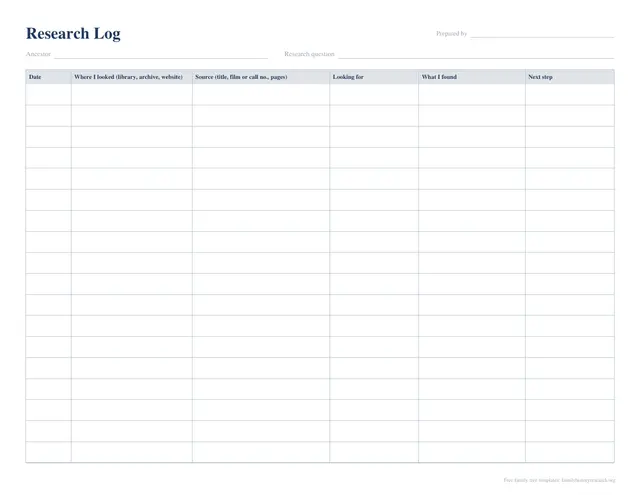
The empty boxes are where we start
Tell us about one person and the names you have, and we'll go after the generations behind them. We read the original records (census pages, draft cards, certificates, passenger lists) and write up who your people were, with every fact tied to the record it came from. One person, $49, by email within 7 days. If we can't find them in the records, you get your money back.
Start a report · $49Read a finished report
A gift that lands: order by December 12 and it reaches you before Christmas. It can be about someone who has died, or for someone living (we trace the family they came from).
Log the misses too
The most useful line in a research log is often “not there”. Six months later you won't remember whether you already checked the 1910 census for the family in Lucas County, or whether you searched under Kowalski only and not Kovalski. A line that says “1910 census, Lucas Co., Ohio, searched Kowalski, Kovalski, Kowalsky: not found” saves you the afternoon.
Write the source precisely enough to find again: the collection's name, the website or archive, and the page, sheet or film number. One way that works well: keep one log per question (“Where was Josef born?”) rather than one per person, so each log tells a single story.
Not sure where to look next? Here is where to find the records, sorted by what you're trying to find.
Other genealogy forms
Questions
What should I write under ‘next step’?
The one search the result points to. Found a 1920 census entry saying he immigrated in 1907? The next step is the 1907 passenger lists. A log with next steps written down is a to-do list you can pick up any time.
The example family in the maker is made up. The charts are drawn in your browser; we never see what you type.