4 or 5 generations · numbered · free PDF
Pedigree chart
A pedigree chart, or ancestor chart, shows one person and their direct ancestors: two parents, four grandparents, eight great-grandparents, each with lines for birth and death, and marriage on the husband's line. It's the form most genealogy guides start you on, and the map you work from afterwards.
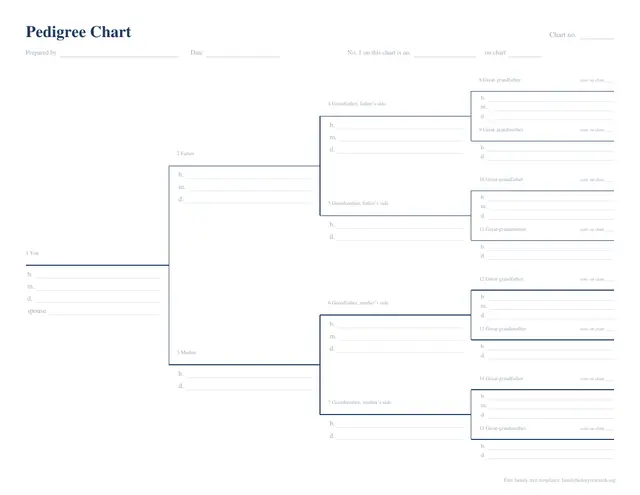
The empty boxes are where we start
Tell us about one person and the names you have, and we'll go after the generations behind them. We read the original records (census pages, draft cards, certificates, passenger lists) and write up who your people were, with every fact tied to the record it came from. One person, $49, by email within 7 days. If we can't find them in the records, you get your money back.
Start a report · $49Read a finished report
A gift that lands: order by December 12 and it reaches you before Christmas. It can be about someone who has died, or for someone living (we trace the family they came from).
How the numbers work
Every box on a pedigree chart has a number, and the numbers follow one rule: a person's father is twice their number, and their mother is twice their number plus one. You are 1. Your father is 2 and your mother 3. Your father's parents are 4 and 5; your mother's are 6 and 7. Your great-grandparents are 8 to 15.
Two things fall out of that rule. Every man on the chart except number 1 has an even number and every woman an odd one, and you can work out anyone's place from their number alone: 13 is the mother of 6, who is the father of 3, your mother. Genealogists call this Ahnentafel numbering (German for “ancestor table”), and it's why a person's number is a handy file label for their papers.
When you run out of room
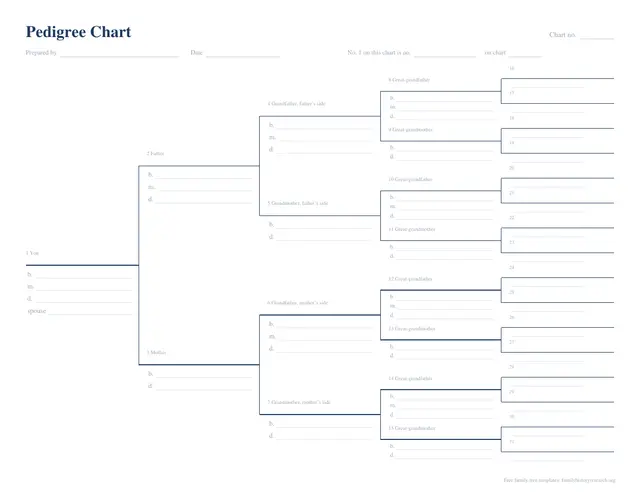
Four generations fill a page. When you know more, start a new chart with one of the people in the last column as its number 1, and write the link on both charts: on the old one, “cont. on chart 2” beside that ancestor; on the new one, “No. 1 on this chart is no. 12 on chart 1” at the top. A family's papers end up as a small stack of linked charts, and the numbers tie them together.
What goes on the lines
b. is born, m. is married (on the husband's line, for the couple) and d. is died, each with a date and a place. Write places from smallest to largest: town, county, state, country, as they were called at the time. Women go under their maiden names. When a date is an estimate, say so: abt. 1871.
Other charts
Questions
What's the difference between a pedigree chart and a family tree?
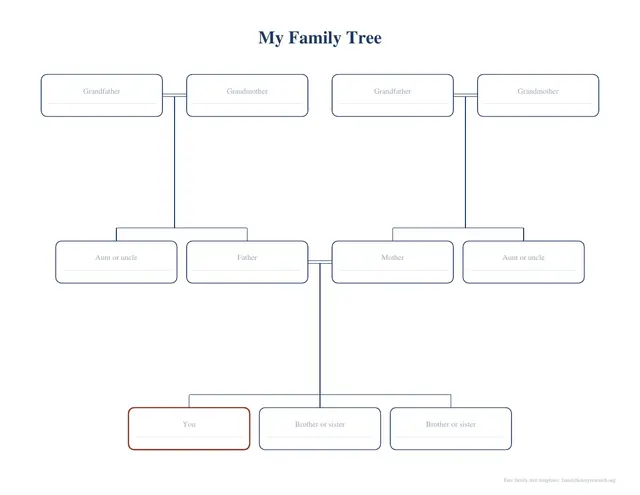
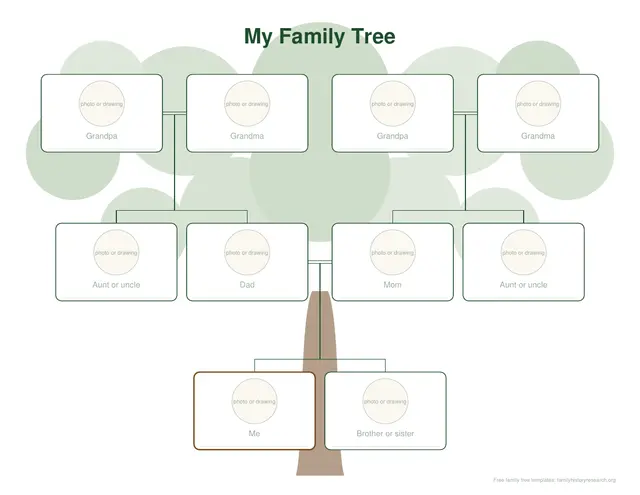
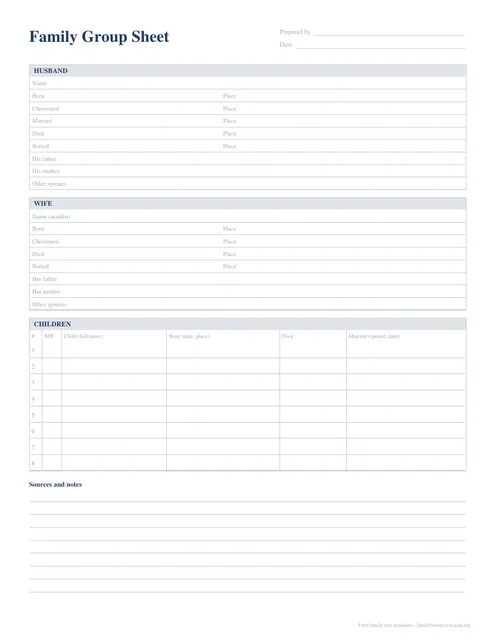
A pedigree chart shows only direct ancestors: parents, grandparents and so on, with no brothers, sisters, aunts or uncles. A family tree in the everyday sense shows the whole family. Genealogists use the pedigree chart to see which lines go back how far, and a family group sheet for each couple to hold the brothers and sisters.
Is a pedigree chart the same as an ancestor chart?
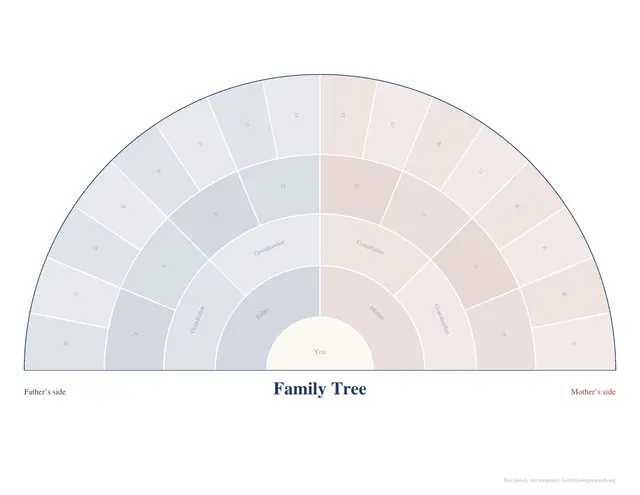
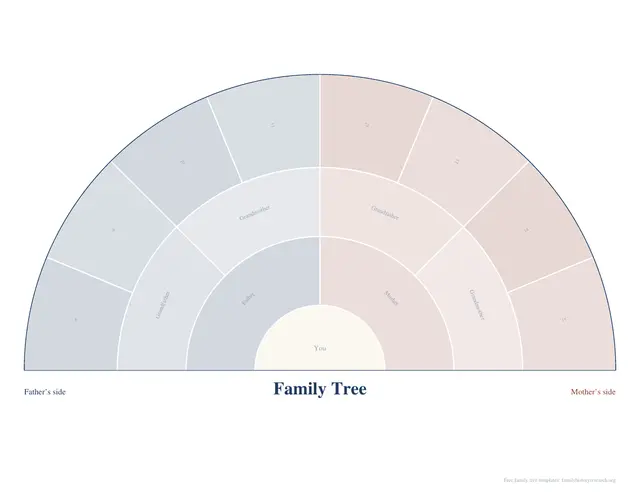
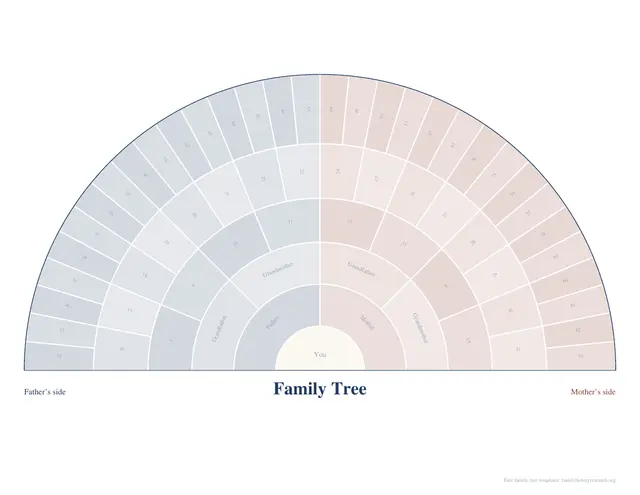
Yes. Pedigree chart, ancestor chart and ancestral chart all mean the same form. A fan chart shows the same people in a half circle.
Why is the marriage on the father's line only?
Because the marriage belongs to the couple, and on a pedigree chart the couple is always a pair of numbers, 2n and 2n+1. By convention it's written once, on the husband's line, to save space.
The example family in the maker is made up. The charts are drawn in your browser; we never see what you type.