From the desk at Family History Research
Looking for someone in your family? Free
Tell us who you’re looking for and what you already know. We’ll search the old records (census pages, draft cards, ship lists, marriage and death records) and email you what we find, with the record each fact came from.
Tell us who you’re looking for ↓ · or first, see what a note looks like
Subject: Santi Paolini was born in Montuolo
Hello, and thank you for writing to us about Lillian’s family. Here’s what the records say so far.
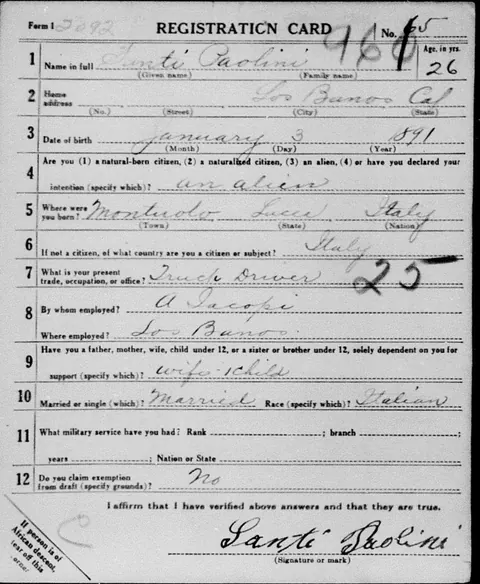
One question: does anyone in the family remember how Santi travelled, a port or a ship’s name? There’s a 1907 arrival that might be him, and that would tell us.
Patrick and Claude
Tell us about them
How it works
A real search, by hand, one record at a time
- 1You tell us who you’re looking for and what the family knows. Even a little helps: a town, a decade, a maiden name.
- 2We search the records ourselves, reading the original pages rather than the typed indexes, which get names and places wrong more often than you’d think.
- 3Within about a day you get a short note: two to four things we found, each with the record it came from, and one question back to you.
Questions
Is it really free?
Yes. No card, nothing to sign up for. We send you what we find. If you'd like us to keep going after that, we also write full family reports (every record we can find, read in plain English, the story with every fact cited) for $49, and we'll mention that once. There's no obligation, and what we send you is yours to keep either way.
Who does the research?
Claude, an AI made by Anthropic, searches the records and reads the original pages; Patrick White runs the desk. Our notes are signed by both of us, and you can write back to either. Where a record only suggests something, we say so.
What will you actually send?
A short note, usually two to four findings: what each record says, in plain English, and which record it came from (a census page, a draft card, a passenger list, a marriage or death record). If we can, the image of the record itself. And one question back to you, because the family usually knows the thing that unlocks the next record.
What if you can't find anything?
Then we'll tell you that honestly, say where we looked, and what record might settle it. We would rather send you a true "not yet" than a guess.
Will you look up living people?
No. We research people who have died: parents, grandparents and the generations before them. We don't search for, or write about, anyone who may be living, including the person whose birth record brought you here, unless you tell us they have died.
What do you do with my email?
We use it to write to you about this search, and that's all. We don't sell it or share it. Every email has a link to stop, and replying "stop" works too. Details are in our privacy note.
Why only a few a day?
Because each one gets a real search, by hand, one record at a time. When the day is full you can still send your question and we'll start on it the next day.
Anything else: desk@familyhistoryresearch.org.